Conclusion first: orotic acid is scientifically interesting because it sits at the intersection of pyrimidine biochemistry, heterocyclic chemistry and metal-salt formulation. Its derivatives should not be understood as one uniform “orotate” ingredient family. The parent acid, its monohydrate/anhydrous forms and its potassium, magnesium, zinc, calcium and lithium salts differ in stoichiometry, hydration, elemental loading, solubility and—most importantly—the strength of evidence supporting specific biological claims.
That makes this category a good example of why modern ingredient science needs two disciplines at the same time: chemistry tells us what the material is; evidence tells us what we can responsibly say about it. Nanchang Polis Biotech Co., Ltd. currently groups seven related products in its Orotic Acid Derivatives portfolio, providing a useful framework for understanding the family.
.jpg)
Orotic Acid Is an Intermediate in Pyrimidine Biosynthesis—not “Vitamin B13” in the Modern Nutritional Sense
Orotic acid has historically been called “vitamin B13,” but it is not considered an essential vitamin. In human biochemistry, it is an intermediate in the de novo pathway that constructs pyrimidine nucleotides. The pathway builds the pyrimidine ring, produces orotate, attaches a phosphoribosyl group to form OMP and then decarboxylates OMP to UMP. UMP is the first pyrimidine nucleotide in the pathway and feeds the synthesis of other pyrimidine nucleotides needed for RNA, DNA and cellular metabolism.
This is not a new hypothesis. Human orotic-acid biosynthesis was experimentally characterized decades ago, and modern reviews continue to place orotate at the center of de novo pyrimidine metabolism. A 2015 review also emphasized that orotic acid has biological roles beyond being a passive intermediate, while cautioning that its metabolic effects depend strongly on context and dose.
Simple explanation: orotic acid is best viewed as a biochemical “junction molecule.” It is made on the way to pyrimidine nucleotides, but chemists can also isolate it, use its carboxyl group to make salts, or modify the heterocyclic scaffold to create derivatives.
How Orotic Acid Is Made: Biology and Industrial Chemistry Take Different Routes
Biological route
In cells, carbamoyl phosphate and aspartate are converted through carbamoyl aspartate and dihydroorotate to orotate. Dihydroorotate dehydrogenase performs the oxidation step that produces orotic acid. Orotate is then converted through OMP to UMP.
Chemical synthesis
Industrial chemistry does not have to copy the cellular pathway. Literature and patents describe several synthetic approaches. One active Chinese patent, CN111499582B, describes a route beginning with urea and maleic anhydride to form a maleuric/maleyl-urea intermediate, followed by controlled oxidative/bromide chemistry, alkaline treatment, acidification, crystallization and drying to obtain orotic acid. Other laboratory methods use different pyrimidine-ring-building strategies.
Important: the synthesis example above is cited to explain known chemistry. It does not state or imply that Polis Biotech or any specific manufacturing partner uses this exact process.
.jpg)
Why Orotic Acid Monohydrate and Anhydrous Orotic Acid Need Separate Specifications
NIST identifies anhydrous orotic acid as CAS 65-86-1 and notes 50887-69-9 as a hydrate; TCI identifies 50887-69-9 specifically as orotic acid monohydrate. Crystal water may look like a small detail, but it changes formula mass and can alter mass-based assay and drying behavior.
Polis therefore lists Orotic Acid Monohydrate and Orotic Acid Anhydrous as separate products. R&D teams should preserve that distinction in specifications, reference standards, raw-material calculations and stability work.
What Changes When Orotic Acid Becomes a Mineral Orotate?
Orotic acid contains a carboxylic-acid group. Deprotonation allows the orotate anion to form salts with metal cations. This sounds simple, but the cation charge changes stoichiometry. A monovalent cation such as K⁺ can pair differently from a divalent cation such as Ca²⁺, Mg²⁺ or Zn²⁺. Crystal water can further change the formula mass.
Elemental mineral fraction (%) = (atomic mass × number of mineral atoms in the defined formula ÷ molecular weight of the defined salt) × 100
That equation explains why “500 mg of an orotate” does not mean “500 mg of mineral.” For example, Polis publishes Potassium Orotate as C₅H₃N₂O₄K, MW 194.19, whereas Calcium Orotate is published as C₁₀H₆CaN₄O₈, MW 350.25. Different salts therefore require different elemental calculations.
| Product |
Scientific / Formulation Question |
Evidence Caution |
Product Link |
| Orotic Acid Monohydrate |
Crystal water, drying and assay basis |
Do not compare directly with anhydrous material without correcting identity. |
View |
| Orotic Acid Anhydrous |
Parent pyrimidine acid without crystal water |
Biological pathway relevance does not automatically establish a health benefit from supplementation. |
View |
| Potassium Orotate |
Monovalent potassium salt; elemental K calculation |
Do not infer a unique therapeutic effect from the orotate ligand alone. |
View |
| Magnesium Orotate |
Mg salt form, hydrate state, elemental Mg and dissolution |
Clinical literature exists, but results depend on indication, formulation and study design. |
View |
| Zinc Orotate |
Zinc delivery, dissolution and pharmacokinetics |
Older animal pharmacokinetic data show distinct behavior, not a universal superiority claim. |
View |
| Calcium Orotate |
Elemental calcium fraction and formulation |
Recent calcium guidance describes calcium-orotate absorption as not well studied. |
View |
| Lithium Orotate Monohydrate |
Low-conductivity organic lithium salt; active research topic |
2025 Nature results are preclinical and do not establish approved human AD treatment. |
View |
Different Orotate Salts Do Not Have One Shared “Bioavailability Advantage”
This is where scientific discipline matters. Marketing language often assumes that attaching a mineral to orotate automatically produces superior absorption or intracellular delivery. The evidence does not support such a blanket conclusion.
An older rabbit study comparing zinc sulfate, zinc pantothenate and zinc orotate found that zinc orotate showed different pharmacokinetic behavior, including slower oral absorption than the soluble salts. A recent calcium consensus statement notes that calcium orotate is relatively low in elemental calcium and that its bioavailability is not well studied. By contrast, magnesium orotate has a larger clinical literature, including cardiovascular studies and more recent research in combination interventions—but that evidence cannot simply be transferred to calcium, zinc or lithium orotate.
Scientific rule: the shared orotate ligand is a chemical relationship, not proof of a shared clinical effect. Each salt needs its own evidence base.
Lithium Orotate Is the Most Visible Emerging Research Signal—But the Evidence Boundary Matters
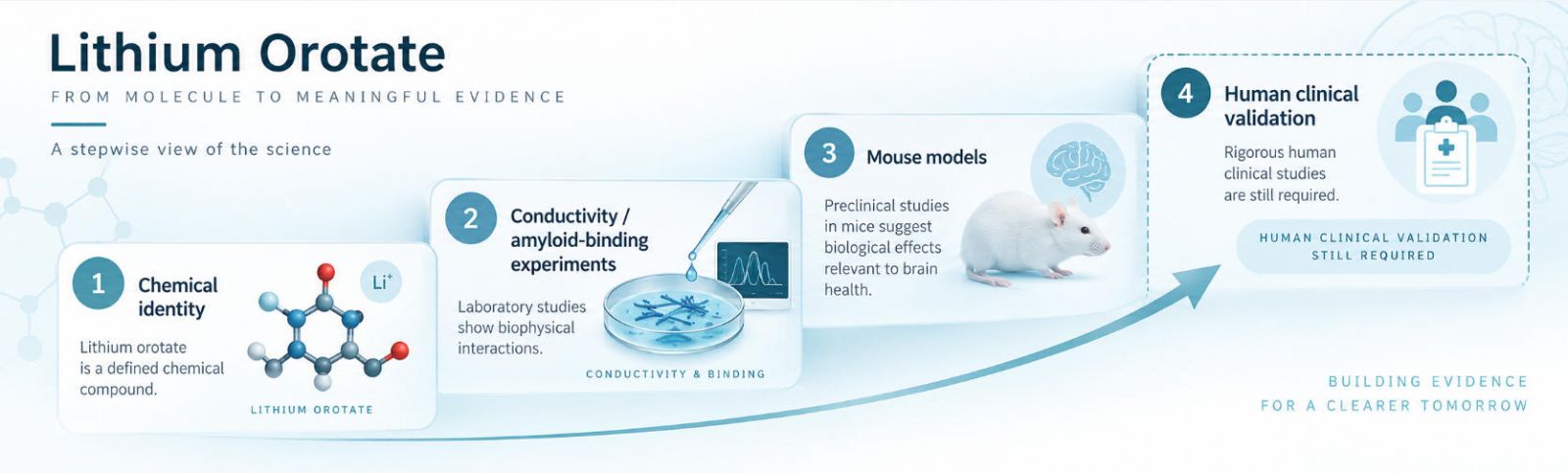
A 2025 Nature study brought renewed attention to Lithium Orotate Monohydrate. The researchers found that endogenous lithium was reduced in brain tissue in mild cognitive impairment and Alzheimer's disease, and that amyloid could sequester lithium. In mouse models, lithium orotate showed lower amyloid binding than lithium carbonate and prevented or reversed several pathological and memory-related changes at low lithium exposure.
This is scientifically important, but the correct 2026 interpretation is still preclinical research signal. The study does not establish that lithium orotate is an approved preventive or treatment for Alzheimer's disease in humans, nor does it establish a consumer dose. Responsible technical content should preserve that boundary.
Where Magnesium, Zinc and Calcium Orotate Research Differs
Magnesium Orotate has been studied clinically for several indications, and a 2024 randomized controlled trial evaluated a combination containing magnesium orotate, probiotics and CoQ10 in major depressive disorder. Because it was a multi-component intervention, the study cannot isolate the effect of magnesium orotate alone. Older cardiovascular literature is broader, but formulation, dose and indication still matter.
Zinc Orotate has older pharmacokinetic research showing that its dissolution and absorption profile differs from soluble zinc salts. That is useful for formulation science but not evidence for universal superiority.
Calcium Orotate is chemically well defined, but a 2026 calcium-supplement consensus statement describes its absorption as not well studied and its elemental-calcium content as relatively low compared with calcium carbonate. This is a useful example of why chemical novelty and clinical evidence should not be confused.
How Formulation Scientists Should Choose Among Orotate Salts
Start with the required ionChoose potassium, magnesium, zinc, calcium or lithium because the formulation requires that ion—not because “orotate” is assumed to confer one universal effect.
Calculate elemental loadingUse the exact molecular formula and hydrate state. Finished-product dose calculations should be based on elemental mineral where relevant.
Check solubility and processingSalt form can change dissolution, pH response, granulation, tablet size and suspension behavior.
Match evidence to claimsResearch on one orotate salt, one species or one indication should not be transferred to another product without evidence.
FAQ: Chemistry, Formulation and Research Questions
1. What is orotic acid biologically?
Orotic acid is a normal intermediate in de novo pyrimidine nucleotide biosynthesis. It is converted to orotidine monophosphate and then UMP, which feeds the broader pyrimidine nucleotide pool. It is not correctly described as an essential vitamin.
2. What is the chemical difference between orotic acid monohydrate and anhydrous orotic acid?
The orotic-acid molecule is the same core compound, but the monohydrate contains one stoichiometric water molecule in the crystal. This changes formula mass, water content and mass-based assay interpretation, so the two forms require separate specifications.
3. Are all orotate salts more bioavailable than conventional mineral salts?
That general claim is not supported. Different orotate salts have different evidence bases. A recent calcium consensus statement, for example, describes calcium-orotate absorption as not well studied, while older zinc-orotate pharmacokinetic work found behavior that differed from soluble zinc salts. Each salt should be evaluated on its own evidence.
4. Why is lithium orotate receiving renewed research attention?
A 2025 Nature study reported that lithium orotate showed reduced amyloid binding and prevented or reversed pathological changes in Alzheimer’s mouse models at low lithium exposure. This is important preclinical research, but it does not establish lithium orotate as an approved treatment for Alzheimer’s disease in humans.
5. How are orotate salts generally prepared?
At a chemical level, the carboxylic-acid function of orotic acid can form salts with suitable metal bases or salts under controlled conditions, followed by crystallization and drying. Exact manufacturing routes, hydrate states and purification steps vary by product and producer.
6. Why should formulation scientists care about stoichiometry and hydration?
Because the counter-ion charge and crystal water change molecular weight, elemental-mineral fraction, solubility and processing behavior. A formulation should be calculated using the defined commercial salt—not the mass of 'orotate' as a generic category.
Sources & Verification Notes
NCBI / pyrimidine metabolism. Orotic acid is an intermediate in de novo pyrimidine nucleotide synthesis and is converted through OMP to UMP.
Pathway review
Löffler, Carrey & Zameitat, 2015. Review: “Orotic Acid, More Than Just an Intermediate of Pyrimidine de novo Synthesis.”
PubMed
CN111499582B. Example of a modern patented chemical synthesis route to orotic acid; cited for chemistry context only.
Google Patents
Aron et al., Nature 2025. “Lithium deficiency and the onset of Alzheimer’s disease.” Preclinical mouse-model evidence for lithium orotate; not an approved human-treatment claim.
Nature article
Andermann & Dietz, 1982. Comparative pharmacokinetics of zinc pantothenate, zinc sulfate and zinc orotate in rabbits.
PubMed
Endocrine Society of India Skeletal Health Taskforce, 2026. Calcium-supplement consensus statement noting limited data for calcium orotate.
Consensus statement
Polis Biotech public product pages. Used for the current seven-product portfolio and company-published identities/specifications.
Discuss an Orotic Acid or Orotate Development Project
For a useful technical discussion, specify the required salt or hydrate, destination market, intended use, analytical target, sample quantity and expected commercial scale. This makes it easier to align chemistry, documentation and sourcing from the beginning.
Nanchang Polis Biotech Co., Ltd.
Email: sales@polisbiotech.com
Tel: +86-791-88172690 · Mobile / WeChat: +86-13870623110
Web: www.polisbiotech.com



 Add: Hi-tech Pioneering Park,No.18 Gaoxin Road(2)Gaoxin District Nanchang 330029 Jiangxi china
 Tel: +86-791-88172690
 E-mail: sales@polisbiotech.com