Conclusion first: buying orotic acid or an orotate salt in 2026 should begin with identity control, analytical comparability and supply repeatability—not with the lowest quoted price. The category looks simple on a purchasing list, but it contains different hydration states and different metal salts. A buyer who treats them as one commodity can create avoidable problems in specification matching, elemental calculations, regulatory review and downstream formulation.
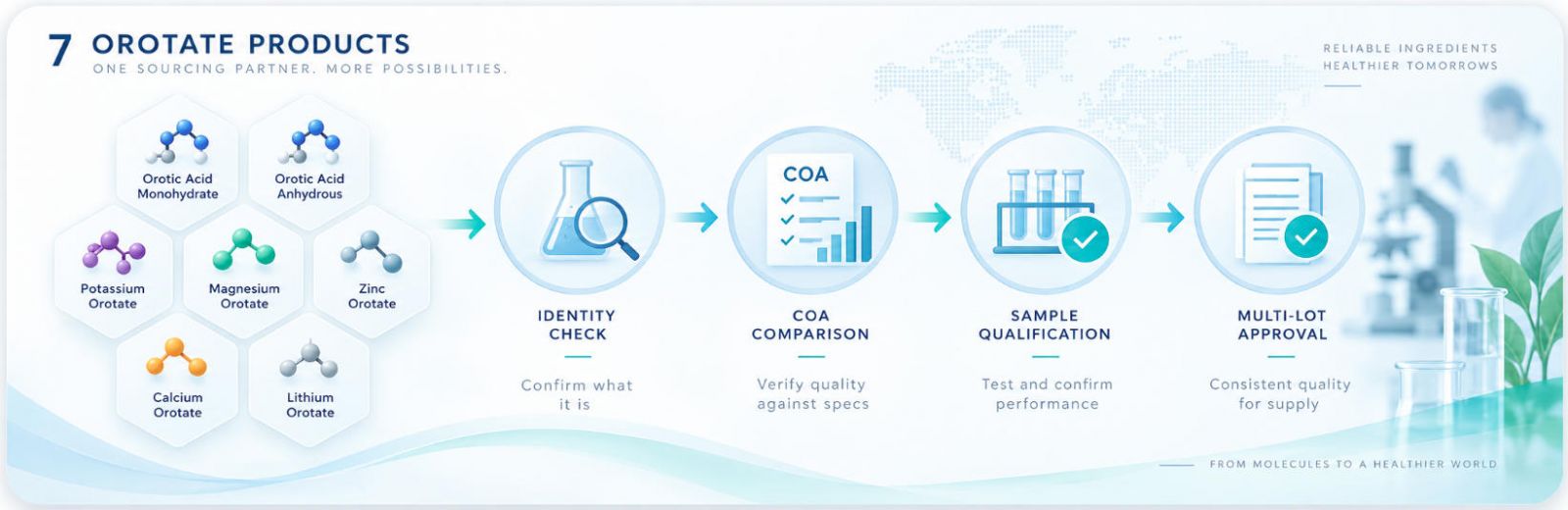
Nanchang Polis Biotech Co., Ltd. supplies a seven-product orotic-acid family covering orotic acid forms and mineral orotate salts. For international sourcing teams, the practical advantage of a broad portfolio is not that every product is interchangeable; it is that procurement can discuss several related forms with one technical-commercial interface and compare the right grade before sampling.
2026 Procurement Rule #1: Confirm the Exact Chemical Form Before Comparing Price
The most important sourcing issue in this category is deceptively basic: “orotic acid” can refer to different hydration states. NIST lists CAS 65-86-1 for anhydrous orotic acid and notes 50887-69-9 as the hydrate. Tokyo Chemical Industry separately identifies 50887-69-9 as orotic acid monohydrate. That distinction matters because water of crystallization changes formula mass and the interpretation of assay on a mass basis.
Buyer takeaway: the first comparison table in an RFQ should contain product name, hydration state, CAS, molecular formula, molecular weight, assay basis and test method. If one of these fields is inconsistent, pause the quotation comparison until identity is clarified.
Polis currently lists both Orotic Acid (the hydrated form associated with CAS 50887-69-9) and Orotic Acid Anhydrous (CAS 65-86-1). For procurement, having both forms visible is useful only when the buyer treats them as separate SKUs with separate specifications.
All Seven Products Should Be Qualified as Separate Materials
| Product |
Published / Reference Identity |
Why Buyers Should Treat It Separately |
Product Link |
| Orotic Acid Monohydrate |
CAS 50887-69-9 |
Hydration changes molecular weight, assay basis and drying behavior. |
View product |
| Orotic Acid Anhydrous |
CAS 65-86-1 |
Anhydrous identity should be confirmed independently from the hydrate. |
View product |
| Potassium Orotate |
CAS 24598-73-0 |
Monovalent cation changes molecular weight, elemental loading and formulation behavior. |
View product |
| Magnesium Orotate |
Orotic acid magnesium salt |
Divalent salt chemistry and hydrate state must be defined by the commercial specification. |
View product |
| Zinc Orotate |
CAS 68399-76-8 |
Elemental zinc loading, water and impurity profile require their own limits. |
View product |
| Calcium Orotate |
CAS 22454-86-0 |
Calcium content and exact salt form matter more than the shared “orotate” name. |
View product |
| Lithium Orotate Monohydrate |
CAS 5266-20-6 |
Research interest has increased, but regulatory and application claims require extra caution. |
View product |
These seven products are also grouped in the Orotic Acid Derivatives portfolio. From a sourcing perspective, portfolio breadth is useful when it reduces search and communication cost, but every salt still needs a dedicated specification and approval file.
What “Reliable Supply” Should Mean to a B2B Buyer
Reliability is measurable. It should mean that the same agreed specification can be reproduced, tested with a stable analytical method and delivered with traceable documentation. A supplier relationship becomes stronger when purchasing, QC and R&D use the same definition of “same material.”
Identity controlCorrect name, CAS, hydrate state, formula and specification must agree. This is especially important for anhydrous vs monohydrate orotic acid.
Analytical comparabilityAssay, water, elemental content and impurities are only useful when the test method and reporting basis are understood.
Multi-lot consistencyA buyer should review several lots where possible. One excellent sample is not evidence of routine commercial consistency.
Change controlRaw-material source, production site or major analytical-method changes should be communicated when they can affect an approved specification.
Polis's public Custom Synthesis page states that analytical support can include HPLC, GC, MS, ¹H/¹³C-NMR, IR, UV-Vis, elemental analysis and X-ray diffraction, with supply quantities ranging from grams and kilograms to tons. For buyers, the significance is not that every routine lot requires every technique; it is that the sourcing discussion can be matched to the analytical question instead of relying only on a generic COA.

COA Review: Move From “Pass / Fail” to “Is the Method Fit for Purpose?”
A COA is often treated as the end of quality evaluation. In specialty ingredients it should be the beginning. An assay value without method context can hide differences in sample drying, titration basis, chromatographic calculation or hydrate correction. The same is true for elemental content in mineral orotates.
Elemental fraction (%) = (atomic mass of the mineral × stoichiometric count ÷ molecular weight of the defined salt) × 100
For example, Polis publishes potassium orotate as C₅H₃N₂O₄K with molecular weight 194.19. Calcium orotate is published as C₁₀H₆CaN₄O₈ with molecular weight 350.25. The elemental percentages are therefore inherently different, even before considering water or specification tolerances. This is why purchasing by “kg of salt” and purchasing by “kg of elemental mineral” are not the same commercial calculation.
2026 Sourcing Trend: Documentation Is Part of the Product
Global ingredient sourcing is increasingly document-heavy. The same orotate can face different classification, labeling or permitted-use rules depending on whether it enters pharmaceutical R&D, a food supplement, a research reagent or another finished product. FDA's substance database, for example, identifies orotic acid as a substance but explicitly notes that a UNII does not mean regulatory approval. This is an important distinction for procurement teams: chemical identity is not the same as market authorization.
Accordingly, a professional RFQ should specify the destination country and intended use. That enables the supplier to provide the most relevant documentation and prevents late-stage discoveries that the buyer needs an additional declaration, impurity panel or market-specific assessment.
Compliance note: this article does not state that any orotic acid or orotate salt is automatically authorized for every food, supplement, pharmaceutical or therapeutic use. Buyers should evaluate the destination market, use level, regulatory category and finished-product requirements independently.
A Better 2026 RFQ for Orotic Acid and Orotate Salts
| RFQ Field |
Weak Request |
Better Request |
| Identity |
“Orotic acid” |
Exact form, CAS, hydrate state and target specification |
| Quality |
“High purity” |
Assay method, water, elemental content, impurity limits and required certificates |
| Quantity |
“Bulk” |
Sample quantity, validation batch, annual forecast and order size |
| Application |
Not stated |
R&D / pharma intermediate / ingredient / other intended use |
| Market |
Not stated |
Destination country and buyer's regulatory / customer-document checklist |
| Supply |
Price only |
Lead time, packaging, shelf life, repeat supply, change notification and export documents |
FAQ: Procurement Questions Buyers Commonly Ask
1. What should a buyer verify first when sourcing orotic acid from China?
Verify the exact chemical identity and hydration state before price. Orotic acid anhydrous is commonly identified as CAS 65-86-1, while the monohydrate is associated with CAS 50887-69-9. Confirm that the product name, CAS, formula, molecular weight and COA all describe the same form.
2. Is a lower assay limit always a sign of lower quality?
Not necessarily. Assay must be interpreted together with hydrate state, water content, test method and intended application. A monohydrate and an anhydrous grade should not be compared on a mass basis without understanding the specification and analytical method.
3. What documents should professional buyers request?
At minimum, request a current COA, specification/TDS and SDS. Depending on application and market, buyers may also need chromatograms, impurity or elemental data, residual-solvent information, microbiological data, origin statements, regulatory declarations and change-control commitments.
4. How can a buyer assess batch consistency before a long-term contract?
Compare multiple recent COAs rather than one sample. Look for the trend and spread of assay, water, pH or other key parameters, ask whether the analytical method is fixed, and agree on notification rules for changes in manufacturing source, raw materials or test methods.
5. Are calcium, magnesium, zinc, potassium and lithium orotates interchangeable?
No. They differ in cation, stoichiometry, hydration, molecular weight, elemental loading, solubility and intended use. They must be qualified as separate materials even though they share the orotate moiety.
6. What makes a sourcing partner useful beyond supplying a sample?
For B2B buyers, value comes from correct grade matching, analytical-document support, communication across gram-to-commercial quantities, packaging coordination, export documentation and stable re-supply. These factors reduce requalification work and sourcing risk.
Sources & Verification Notes
NIST Chemistry WebBook. Orotic acid CAS 65-86-1; NIST also notes 50887-69-9 as the hydrate.
NIST reference
Tokyo Chemical Industry. Orotic Acid Monohydrate, CAS 50887-69-9.
TCI reference
FDA GSRS / UNII. Orotic acid substance identity; UNII availability does not imply regulatory approval.
FDA substance record
Polis Biotech public product and custom-synthesis pages. Used for current product links, published specifications and available analytical-service descriptions.
Request a Quote, Sample or Technical Review
When contacting Polis Biotech, include the exact product, intended market, application, target specification, annual demand and any analytical or documentation requirements. This helps the team match the correct grade before quotation and sample qualification.
Nanchang Polis Biotech Co., Ltd.
Email: sales@polisbiotech.com
Tel: +86-791-88172690 · Mobile / WeChat: +86-13870623110
Web: www.polisbiotech.com



 Add: Hi-tech Pioneering Park,No.18 Gaoxin Road(2)Gaoxin District Nanchang 330029 Jiangxi china
 Tel: +86-791-88172690
 E-mail: sales@polisbiotech.com